
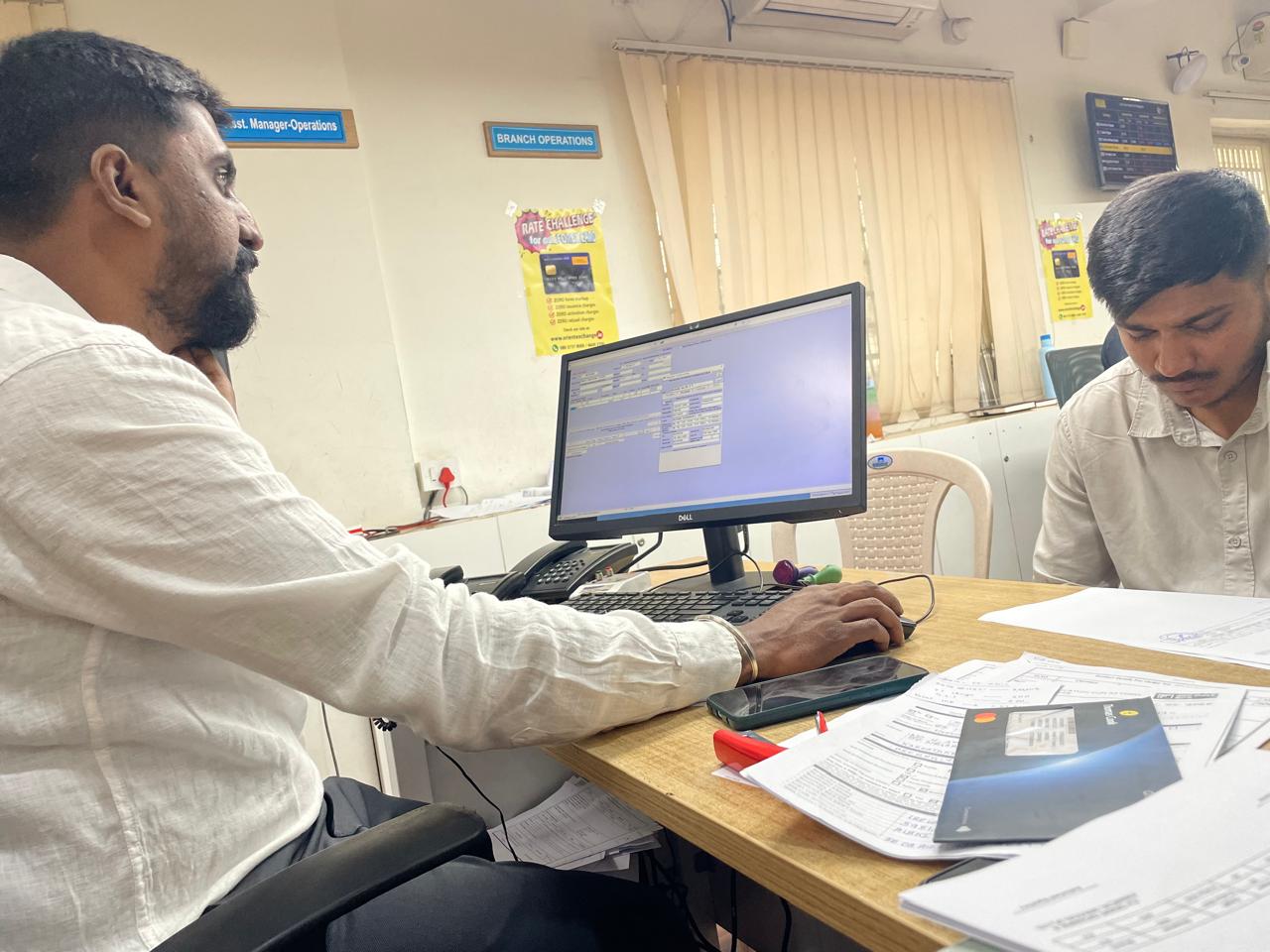
Who Orient Exchange is
A licensed money changer that grew up on paperwork, now running its branch operations on agentic AI.
Orient Exchange has been buying and selling foreign currency in India since the early 2000s, and today holds an RBI Category II Authorized Dealer license, covering currency exchange in 34 currencies, forex cards, international money transfers to over 100 countries, and student payment cards for education fees abroad. It runs 26 branches across cities including Bangalore, Mumbai, Delhi, Hyderabad, Kochi, Chennai, Pune, Kolkata, Chandigarh, Ahmedabad, Vadodara, and a dozen more, and has served more than 300,000 customers with a 4.8-star Trustpilot rating across over a thousand reviews.
None of that runs on a single monolithic core system. Like most financial services businesses this size, Orient Exchange's daily operations sit across a booking platform, partner processing banks including IDFC, IndusInd, YES Bank and RBL, spreadsheet-based book reports per branch, scanned identity documents, and a compliance team that has to make sure every one of those pieces agrees with every other piece, every day. That gap - between what the business runs on and what actually gets typed into it - is where Orient Exchange brought in Makez.ai, first for one job, and now for two.
The KYC bottleneck, and how it closed
Before reconciliation, there was the counter. Every new order needed a person, a passport, and roughly half an hour.
Orient Exchange's first automation with Makez.ai targeted the slowest part of any branch visit: identity verification. A customer walking in to buy or sell foreign currency has to have their passport, PAN, or other identity document read, checked, and entered correctly before an order can even be created - a step that, done by hand, took a branch staffer 25 to 30 minutes per customer and required hiring dedicated data-entry help at busier locations.
Makez.ai's Document Agent now does the reading. A staff member uploads or emails in a scanned passport, and the agent locates and extracts each field - passport number, issue and expiry dates, date of birth, address, nationality - directly from the document image, drawing a visible bounding box around the exact text it read so the reviewer can check the source at a glance instead of hunting for it. Every extracted field is then handed to a human for a final look before the order goes through; nothing is auto-submitted without a person confirming it.


The result, as covered in Makez.ai's earlier Orient Exchange case study, was a 75% cut in KYC processing time and a customer wait that dropped from 25–30 minutes to under six - with OCR accuracy above 95% on real, sometimes creased or poorly lit branch scans, an 80% team adoption rate before the rollout was even officially announced, and zero layoffs. The rollout reached production in six weeks and scaled branch by branch after that, using the same document management and CRM layer that now underpins Orient Exchange's second automation.
Business teams
Branch staff stopped re-typing passports and started reviewing pre-filled forms.
Document Management & CRM
Every scan, email, and manual upload lands in one place, tied to one order.
Then came the books that didn't balance themselves
Identity verification was solved at the counter. The next bottleneck was upstream of the counter, in the finance function.
Every branch generates its own book of accounts - cheques issued, public buying and selling entries, receipts and payments - and every branch also has its own bank statement to match it against, usually from Axis Bank or one of Orient Exchange's other partner banks. Reconciling the two by hand meant a finance team member opening both files, matching transactions line by line by party name and amount, tracking down cheques that hadn't cleared yet, chasing bank entries that had no corresponding book entry, and rebuilding a Bank Reconciliation Statement from scratch - every cycle, for every branch, including branches like Vadodara that run their own book and bank files independently of head office.
It's exactly the kind of work Makez.ai's Finance & Back Office agents exist for, and it's a textbook fit for what Makez.ai calls a Reconciliation Agent: two structured files, a matching problem, and a compliance deadline attached to getting it right.
Nobody at Orient Exchange was bad at reconciliation. They were doing what a spreadsheet and a bank PDF ask a person to do - read every line, twice, across two documents that were never designed to be compared automatically. - Makez Engagement Team
How the Reconciliation Agent actually runs a branch's books
Three files in, one statement out - with every judgment call left visible for a person to make.
Pick the reconciliation type
Makez.ai supports standard bank reconciliation as well as gateway-specific formats - QR gateway settlements and YES Bank gateway reconciliation for payment processors like PayU, CashFree, and EaseBuzz - because a forex business doesn't only reconcile against one kind of statement.
Upload the book report, the bank statement, and the last BRS
The Document Agent that reads passports at the counter is the same engine that reads a branch's Excel book report and its bank statement here - no reformatting, no manual column mapping. The agent also picks up the previous reconciliation statement, so brought-forward items - a cheque still pending clearance from last cycle - carry through instead of resetting to zero.


The agent matches, scores, and explains every pairing
This is where a Reconciliation Agent earns its keep. It doesn't just match on exact amount - it matches on party, cheque number, direction, date, and amount together, scores each match's confidence, and flags anything unusual for review, including a transaction that was booked as one payment but settled in the bank as a split across two entries.

Everything that doesn't match gets sorted, not buried
Cheques issued but not yet cleared land in a Book Only list. Bank credits and debits with no matching book entry - genuinely new activity that needs to be investigated and recorded - land in a Bank Only list. Both carry a clear status and a plain reason, so the finance team reviews a short, explained queue instead of re-reading two full statements.


The statement closes itself
Once the review is done, Makez.ai produces the Bank Reconciliation Statement directly - closing balance per the books, adjustments for cheques issued but not debited, cheques deposited but not credited, and items debited or credited in the bank but not yet recorded in the books - arriving at a reconciled balance that should tie out to the bank's closing balance exactly.


Every screenshot above comes from one real reconciliation run at Orient Exchange, with individual customer names, amounts, and account numbers blurred for confidentiality. Nothing about the workflow itself is staged.
One run, in numbers
This is a single branch reconciliation cycle, not a projection - the same run shown in the screenshots above.
| Metric | Before Makez.ai | With the Reconciliation Agent |
|---|---|---|
| Matching book entries to bank entries | Manual, line by line, per branch | Automated 24 of 32 book entries matched automatically |
| Unexplained bank activity | Found late, if at all | 21 entries surfaced and routed for review |
| Cheques pending clearance | Tracked manually across cycles | 13 entries carried forward with status intact |
| Split or partial-amount transactions | Easy to miss | Flagged automatically with the amount difference shown |
| Bank Reconciliation Statement | Rebuilt by hand each cycle | Auto-generated Difference: Nil |
Alongside the KYC numbers from Chapter One - a 75% reduction in processing time and a wait under six minutes - Orient Exchange now runs two of its highest-friction, most error-prone business operations on agentic AI through the same Makez.ai platform, reviewed by the same teams, with nobody added to headcount to make it work.
Automated, not unsupervised
Every screenshot in this story shows a human-in-the-loop system - because a forex dealer's books and a customer's passport are not places to guess.
A person confirms every field
KYC orders show an "Action Required" banner until a reviewer verifies every extracted field. No order submits itself.
Every match has a reason
Match method, confidence score, and flags are visible on every reconciled line, so a reviewer can see why the agent decided what it decided.
Audit trail by default
Access controls, document handling, and audit logging are part of the platform, detailed on Trust, Security & Governance, not bolted on after the fact.
Both agents run on the same underlying Business Context Engine, which is what lets a Document Agent that reads passports and a Reconciliation Agent that reads bank statements share one understanding of Orient Exchange's branches, parties, and document formats instead of being configured as two unrelated tools. New agents get built in Agent Studio, described in plain English rather than code, connected to existing systems through Integration Fabric, and shipped only after passing through Testing & Release - the same pipeline that took the Document Agent from pilot to six-week production rollout.
One platform, redesigned around how finance teams actually work
The screens Orient Exchange's branches use today sit on top of the same Document Management & CRM layer Makez.ai is rolling out across every customer, refreshed for faster scanning and fewer clicks per review.


The specific screens change per business - a forex dealer reconciles bank statements, a manufacturer reconciles purchase orders, a distributor reconciles vendor invoices - but the underlying Business Context Engine, Document Agent, and Reconciliation Agent stay the same, which is why Orient Exchange's second automation took weeks, not the six months the first one needed to prove itself.
How the rollout actually happened
KYC pilot at a single branch
The Document Agent is scoped against real passport, PAN, and identity document formats already in use.
KYC goes live in production
Order creation, document upload, and field verification move from prototype to the branch floor.
Branch-by-branch expansion
Adoption reaches roughly 80% ahead of the formal rollout announcement, spreading across the 26-branch network using a train-the-trainer approach: a Makez.ai session at head office, then each branch lead walks their own team through the workflow with their own documents.
Reconciliation Agent onboarded
The same Document Agent that reads passports is pointed at book reports and bank statements, starting with branches including Vadodara.
A fully reconciled statement, automatically
Book and bank entries match, sort, and close to a nil difference without a manual rebuild - the run shown throughout this story.
More of the back office
The relationship continues - see what's being scoped next below.

Rollout at Orient Exchange was never a single company-wide switch-on. Each branch got its own onboarding session - starting with a plain-language explanation of what the AI agent does and doesn't do, then hands-on practice with real order and reconciliation screens - before that branch's staff started using it on live customer work. That branch-by-branch, session-by-session pattern is also how the Reconciliation Agent is expected to reach the remaining branches, and how any future agent from the Makez.ai roadmap will roll out too.
This is a journey. Two business operations are live. Many more are mapped.
Orient Exchange's agentic AI journey started with one bottleneck, KYC, and grew into a second, bank reconciliation, because the same underlying platform already understood the business. That pattern is what an agentic rollout looks like in practice: it compounds.
A forex network with 26 branches, live order tracking, partner banks, and thousands of monthly transactions has far more candidates for automation than any single project can cover in one pass. What's already working for identity verification and reconciliation extends naturally into the rest of the order lifecycle and the rest of the back office, and scoping that next stage is an ongoing conversation between Orient Exchange and the Makez.ai team, not a one-time engagement that ended when reconciliation shipped.
Many more automations are already on the roadmap for Orient Exchange. This case study will be updated as each one goes live, the same way it was updated to add reconciliation to what started as a KYC story alone. Follow along on Makez.ai's customer stories.
AI agents worth evaluating if you run a forex, money exchange, or financial services business
Orient Exchange started with two. Most multi-branch forex dealers, money changers, and NBFCs carry the same underlying process shapes - identity checks, reconciliation, order tracking, customer contact - and the same agents apply.
Document Agent
Reads passports, PAN cards, and other KYC documents at the counter, so a money changer's identity verification step takes minutes instead of tying up a staff member for half an hour per customer.
Reconciliation Agent
Matches book entries to bank statements per branch, per partner bank - built for exactly the multi-branch, multi-bank reconciliation load a forex dealer or NBFC finance team carries every cycle.
Order Tracking Agent
Gives a forex order - currency purchase, international transfer, forex card load - a visible status across branches, instead of a customer having to call and ask where their order stands.
Contact Agent
Handles routine customer questions - today's rate, required documents, branch hours - so front-line staff spend their time on transactions that actually need a person.
Insights Agent
Rolls up branch-level KYC turnaround, reconciliation exceptions, and volume trends into one view for compliance and operations leadership, instead of 26 separate spreadsheets.
Workflow Copilot
A day-to-day assistant for branch and finance staff working across the Document Agent and Reconciliation Agent, surfacing what needs review next instead of making them check every queue manually.
These aren't hypothetical - they're the same agent categories covered on AI Agents for Business Teams and Finance & Back Office, scoped to how a forex or financial services business actually operates. A finance or operations lead evaluating any of them can see the reconciliation and document-reading versions running on real Orient Exchange data throughout this story, or start with AI agents for financial services for the fuller picture.
Hear from the Orient Exchange team
A short conversation about bringing AI agents into a working forex operation.
Why a regulated forex dealer trusted an AI platform with its books
Three things kept coming up in Orient Exchange's evaluation, and they hold for most finance and operations teams considering the same move.
No engineering team required
Agents are described in plain language and refined in Agent Studio, so a finance or operations lead can shape the workflow directly instead of writing a specification for someone else to build.
One context, every agent
The Business Context Engine is what let a second agent (reconciliation) reuse everything the first agent (documents) already understood about Orient Exchange's branches and formats.
Audit-ready by default
For a business regulated by the RBI, an agent that can't explain a match or show who touched a document isn't a serious option. Every Makez.ai agent keeps that trail.
Teams weighing the same decision usually start with Makez.ai's pricing, a look at how existing systems connect in, and a working session in a live demo against their own documents - not a slide deck.
Other businesses automating with Makez.ai
KYC and reconciliation happened to be Orient Exchange's biggest bottlenecks. Every industry has its own version of "the process was the slow part, not the people."
Financial services businesses considering the same path as Orient Exchange can start with AI agents for financial services, or browse the full set of Makez.ai customer stories for other results across industries.
Common questions about this rollout
What is an AI reconciliation agent?
An AI reconciliation agent reads a company's book of accounts and its bank statement, matches transactions between the two by party, amount, cheque number, and date, and separates the result into matched, book-only, and bank-only entries - then produces a Bank Reconciliation Statement automatically, the way Orient Exchange's is shown doing above.
How long does it take to automate KYC for a multi-branch forex business?
Orient Exchange's Document Agent reached production in six weeks, with branch-by-branch rollout continuing after that across its 26 locations. Timelines vary with document mix and how many core systems need connecting through Integration Fabric.
Can an AI agent read a passport or identity document accurately enough for compliance use?
Makez.ai's Document Agent extracted fields from real, sometimes imperfectly scanned Orient Exchange passports at over 95% accuracy, drawing a bounding box around every source field. Every value is still confirmed by a human reviewer before an order is submitted - accuracy plus review, not accuracy alone.
Does automating reconciliation replace the finance team?
No. The Reconciliation Agent handles matching and first-pass sorting; a person still reviews flagged entries, approves the statement, and makes judgment calls. Orient Exchange added zero headcount and eliminated zero roles across both rollouts.
What happens to transactions the agent can't match automatically?
They land in a Book Only or Bank Only list with a plain-language status - "Pending Clearance" or "Unrecorded" - instead of being dropped silently or requiring someone to re-read the full statement to find them, as shown in the Book Only and Bank Only screenshots above.
How does Makez.ai keep customer and financial documents secure?
Access controls, document handling policy, and audit trails are part of the platform by default, covered in full on Trust, Security & Governance - which is also why every sensitive screenshot in this story is shown with customer data blurred.
What other business functions can Makez.ai automate besides KYC and reconciliation?
The same platform extends to order tracking, customer contact handling, catalog and pricing data, content operations, and operational insights - the agents under evaluation for Orient Exchange's next phase.
See what your own back office looks like automated
Bring a real document, a real bank statement, or a real spreadsheet to a working session - not a slide deck.