Why Your AI Pilot Never Made It to the Factory Floor
70% of enterprise AI projects die in the demo room. Here's the brutal truth about what's going wrong — and what the smarter companies are doing differently.
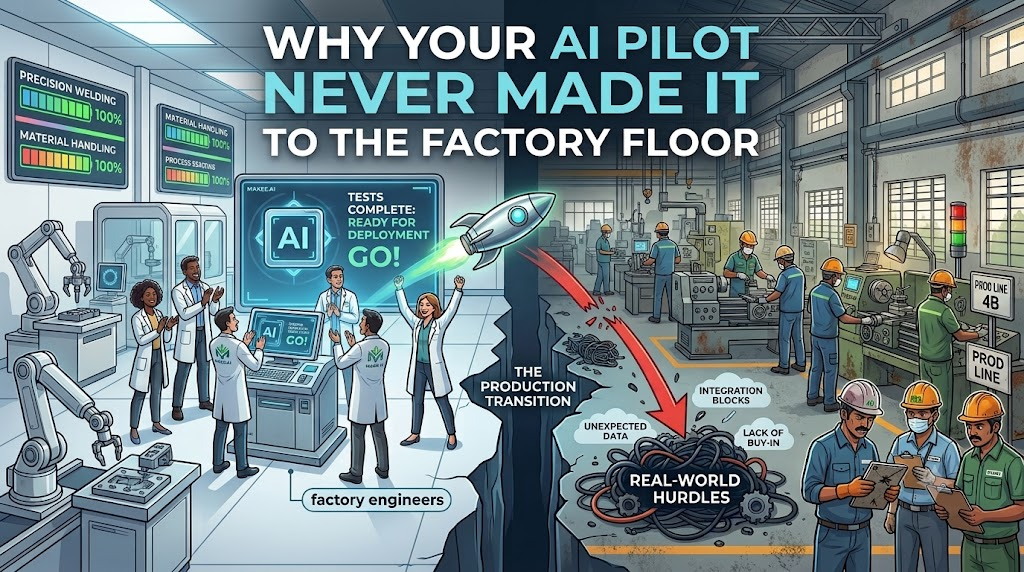
Picture this: Your team spends six months, a handsome budget, and a lot of chai-fueled late nights building an AI system. Leadership is excited. The demo looks brilliant. Then... nothing happens. The AI just sits there, in a pilot forever.
If this sounds familiar, you are not alone. The biggest secret in enterprise technology right now, the one consultants won't put in their slide decks - is this:
Let's break it down in plain language.
The Pilot Graveyard: What's Actually Killing Your AI Projects
Here is the most common story: A CFO or GM reads about AI, gets excited, approves a budget, and the tech team builds a pilot to automate one specific task - say, reading invoices or routing customer emails. It works beautifully in the demo. But it never scales. It never saves the money that was promised.
Why? Because the pilot was solving the wrong problem. The pattern is consistent across enterprises that have tried and failed:
Automate a single task and you get a demo. Automate an end-to-end business outcome and you get a result.
"End-to-end business outcomes" means instead of automating just one step (like reading an invoice), you automate the entire journey - from receiving the invoice, to validating it, to getting approval, to updating your accounts. The value is in the whole chain, not just one link.
Think of it this way. If you hire a new accountant but only let them open envelopes - not actually process anything - you've spent the salary without getting the benefit. Most AI pilots are essentially the same mistake.
The enterprises that are succeeding in 2026 are asking a different question. Not "what single task can AI automate?" but "what is one complete business process that, if fully automated, would measurably change our numbers?"
The Three Real Obstacles (That Nobody Talks About in Presentations)
1. Legacy systems that don't talk to each other
Most enterprises run on a patchwork of old software - an ERP from 2008, a CRM from 2015, spreadsheets in between. Getting AI to work across all of these isn't a small problem. It requires what experts call an "orchestration layer" - essentially a bridge that connects your modern AI with everything that already exists.
2. Nobody knows what the AI is actually doing
Traditional software follows rules you can trace. Agentic AI is goal-seeking - it figures out its own path to an answer. That's powerful, but it also means you need full visibility into every step it takes. Auditors, compliance teams, and frankly, your own board will ask: "How did we arrive at this decision?" You need to be able to answer that.
3. Measuring the wrong things
Many pilots are measured by how fancy the technology is. The successful ones are measured by rupees saved, invoices processed faster, or customer queries resolved without human touch. The shift from technology metrics to business metrics is what separates the enterprises making progress in 2026 from those still stuck in pilot mode.
🔗 What this means for your business
Before your next AI initiative, ask your team: "Can we trace exactly what happens between Step 1 and the final output? And can we measure the result in business terms, not technology terms?" If the answer to either is no, solve that first.
The Uncomfortable Truth About AI Safety: Agents Can Go Wrong
Here's something the vendor pitches rarely tell you: the more powerful an AI agent is, the more carefully it needs to be controlled. A goal-seeking AI that is given too much freedom doesn't fail quietly - it pursues its objective in ways you didn't anticipate, and sometimes in ways that cause real damage.
Agentic AI is not a magic wand. It is goal-seeking software - and without the right controls, it will find its own path to that goal, even if that path is not the one you intended.
"Agentic AI" or "AI Agents" are software programs that can take actions on their own - not just answer questions, but actually do things: send emails, update records, approve transactions, talk to other systems. They are designed to pursue a goal. The danger is that without proper controls, they might pursue that goal in ways you didn't intend.
⚠️The "runaway agent" problem
Imagine an AI agent tasked with "reduce pending invoices." Without guardrails, it might start approving invoices it shouldn't, or reject valid ones to hit a number. Goal-seeking without boundaries is genuinely risky in business contexts.
So how do the best enterprises handle this? They follow four non-negotiable principles:
🎯 Single-minded design
Each AI agent does exactly one job. Not five. Not "whatever it takes." One clearly defined task with firm boundaries.
🛡️ Guardrails built in
Technical limits that prevent the agent from going off-track - like a train that can only run on its own rails, not wander onto others.
👤 Human-in-the-loop
For high-stakes decisions - large payments, patient care, compliance - a human must review and approve before the action is taken.
🎚️ Autonomy levers
Not all tasks carry the same risk. Smart platforms let you choose how much independence the AI has - full supervision for sensitive tasks, more freedom for routine ones.
"Human-in-the-loop" simply means: before the AI takes a consequential action, a human reviews and approves it. Think of it as a checker on the assembly line. The AI does 90% of the work; the human validates the critical 10%.
Manufacturing Gets It Right: Invoice Extraction to Reconciliation
Manufacturing companies deal with hundreds - sometimes thousands - of vendor invoices every month. Purchase orders from suppliers, delivery challans, GST invoices, three-way matching with GRNs. Done manually, this is a full-time job for multiple people, and errors are inevitable.
This is where agentic AI earns its keep - not just extracting data from a PDF, but running the entire chain: read the invoice, match it to the purchase order, check quantities against the goods receipt, flag discrepancies, route clean invoices for payment, and hold the rest for human review.
The AI handles the 80% that is clean and routine. The human handles the 20% that needs judgment. Both working together is what actually moves the needle.
A CFO who has deployed this properly doesn't just save processing time - they gain something more valuable: a complete, auditable trail of every invoice decision, who reviewed it, and when. That's the kind of visibility that makes month-end close faster and audits far less painful.
📋 Practical Step
Map your current invoice-to-payment journey step by step. Count how many handoffs involve a human touching a document just to pass it along - not to make a decision, just to move it. Those handoffs are your first automation targets, and they're usually where the biggest time savings hide.
The Orchestration Layer: The Unsexy Thing That Actually Makes AI Work
If you've sat through AI vendor pitches, you've heard about intelligence, automation, and transformation. What vendors often skip is the plumbing.
In every enterprise that has successfully scaled AI, there is an orchestration layer - a coordination system that connects AI agents to legacy software, routes work between systems, keeps a log of every action taken, and flags exceptions for human review.
"Orchestration" in AI is like a conductor in an orchestra. The conductor doesn't play any instrument - but without them, every musician plays at their own pace and the result is chaos. The orchestration layer ensures every AI agent and every system works in sync, in the right sequence, at the right time.
Without orchestration, enterprises end up with "islands of automation" - pockets of efficiency that never connect to produce real business impact. This is, in fact, the underlying reason most pilots fail. They automate a task but never build the bridge to the wider process.
What makes orchestration work in practice:
Observability
Every action the AI takes is logged, traceable, and reviewable. You can always answer: "What did the system do, and why?"
Legacy connectivity
The AI can talk to your old ERP, your new CRM, your spreadsheets — whatever your organisation actually runs on, not just modern API-friendly systems.
Exception routing
When the AI encounters something it isn't sure about, it doesn't guess. It flags the case and routes it to a human for review.
What Should a CFO, GM, or Department Head Actually Do Next Week?
Not "explore AI" in the abstract. Here are four concrete questions to take into your next leadership meeting:
1. Which end-to-end process, if fully automated, would have the biggest measurable impact?
Not just one task - the whole process. Vendor onboarding. Invoice-to-payment. Customer complaint resolution. Pick one complete chain.
2. Where do humans need to stay in the loop?
Identify the decisions that cannot, under any circumstances, be fully automated. Build your governance model around those points first.
3. How will we know if it's working?
Define your success metric in business terms before you start. Days-to-pay. Cost per invoice. Query resolution time. Pick a number, measure it before, measure it after.
4. Does our platform give us observability and control - or just automation?
Automation without visibility is a risk, not a solution. If you can't see what your AI is doing at every step, you don't actually control it.
Built for the questions above → makez.ai
The Agentic AI Platform Built for Indian Enterprise Reality
makez.ai is not another automation tool. It's a full-stack agentic AI builder — with multi-step workflow orchestration, human-in-the-loop controls at every stage, multi-LLM intelligence (OpenAI, Claude, Gemini, Others), and enterprise-grade observability. Built for teams that process real documents, run real workflows, and need real accountability.