Every ledger has two sides. Makez makes sure they agree.
One reconciliation layer for bank, invoice, PO-to-payment, vendor, payroll, treasury and tax reconciliation - running as AI agents on top of the ERP you already use, not instead of it.
No rip-and-replace. Works alongside SAP, Oracle, Tally, Zoho Books, QuickBooks, NetSuite, Sage and spreadsheets.



One shop, every reconciliation
Whatever you need to reconcile, there's an agent for it
Reconciliation isn't one job, it's a dozen small, repetitive matching jobs spread across banking, procurement, tax and treasury. We built one agent per job, and one dashboard to see all of them.
Bank reconciliation
Matches bank statement lines against your cash book across every account and currency, flags unexplained credits, debits and bank charges same-day.
Invoice / AP reconciliation
Reconciles vendor invoices against your accounts payable ledger, catches duplicate invoices, tax mismatches and rate variances before they are paid.
PO to invoice to payment
Checks purchase order, goods receipt and invoice line by line - quantity, price, tax - before an invoice is cleared for payment. Pre-verification, not post-mortem.
Vendor statement reconciliation
Compares the statement a supplier sends you against your AP sub-ledger, so open items, short-payments and unapplied credits surface before month-end.
Customer / receivables reconciliation
Matches incoming payments and remittance advices against open invoices, so cash application stops eating your collections team’s week.
Intercompany reconciliation
Reconciles balances between entities and subsidiaries before consolidation, so eliminations don’t surface as a fire drill at group close.
Payroll reconciliation
Checks payroll register against bank disbursement, statutory deductions and headcount changes for every pay cycle, in both payroll calendars.
Credit card & expense reconciliation
Reconciles corporate card statements and employee expense claims against policy and GL coding, before reimbursement, not after.
Payment gateway & settlement reconciliation
Matches payment gateway, forex and card-network settlement reports against bank credits and your books - built for exchanges, NBFCs and D2C payment flows.
Inventory & stock reconciliation
Reconciles stock ledgers against physical counts, GRNs and dispatch records for manufacturing and distribution businesses running tight margins.
Tax reconciliation (country-specific)
GST, TDS, e-invoicing and 26AS matching for Indian entities; sales & use tax and 1099 matching for US entities. Covered in full detail below.
Treasury & cash positioning
Rolls up reconciled balances across accounts and entities into a daily cash position, so treasury isn’t waiting on close to know what’s actually available.
The roster
Meet the reconciliation agents
Each agent is scoped to one job, trained on the exceptions specific to that job, and handed off to a human the moment confidence drops. None of them touch your general ledger without a review trail.
Ledger Agent
Pulls daily bank feeds (MT940, camt.053, direct API) and matches every line to the cash book, ranked by confidence.
Match Agent
Reads invoices - PDF, email or portal - and checks them against PO and goods receipt before they ever reach an approver.
Vendor Agent
Chases and reconciles vendor statements automatically, drafting the reply when there’s a genuine short-payment or timing gap.
Tax Agent
Runs the country-specific matching logic described in the India and US sections below, and flags credit at risk before a filing deadline.
Treasury Agent
Reconciles payment gateway, forex and card settlement files against bank credit, purpose-built for exchanges and payment businesses.
Payroll Agent
Confirms every payroll line hit the right account for the right amount, and flags statutory deduction mismatches before filing.
Ledger-to-Ledger Agent
Watches intercompany balances between entities all month, not just at consolidation, so eliminations are clean on the first pass.
Exception Agent
The one agent that never auto-closes anything - it triages every unmatched item to the right human, with the context to resolve it fast.
How it works
A layer beside your ERP, not a replacement for it
Makez reads from the systems you already run, reconciles across them, and writes matched results and journal-ready exceptions back. Your ERP stays the system of record.
Bank feeds
MT940 / camt.053
ERP
SAP, Oracle, Tally, QuickBooks
Vendor documents
Invoices & statements
Tax portals
GST / IRS filings
Payment gateways
Forex & settlement
Makez
Reconciliation layer
Ledger · Match · Vendor
Tax · Treasury · Exception
Auto-matched entries
Back to ERP
Exception queue
Ranked by confidence
Audit trail
Compliance reports
Input
Makez
Output
Makez sits between your data sources and your ERP's general ledger - nothing posts without an audit trail.
Pre-verification
From purchase order to payment
This is the flow most teams start with - catching mismatches before an invoice is approved, not after it's paid and someone has to claw the money back.
Step 1
Purchase order raised
Step 2
Goods receipt / delivery note
Step 3
Vendor invoice received
Step 4
Match Agent checks qty · price · tax against PO + receipt
✓ Approved for payment
! Routed to AP for review
Product
What it looks like on your screen
Reconciliation built around GST, TDS and how Indian banks actually move money
GST input tax credit is only as good as the match behind it, and TDS mismatches surface at the worst possible time - during return filing. The Tax Agent runs both checks continuously instead of once a quarter.
GSTR-2A / 2B matching
Purchase register reconciled against GSTR-2A and GSTR-2B, line by line, so eligible input tax credit is claimed and blocked credit is flagged before the GSTR-3B filing window closes.
E-invoicing & IRN validation
Checks that every eligible outward invoice carries a valid IRN and QR code, and that e-way bill data lines up with the invoice before goods move.
TDS reconciliation (Section 194 series)
Matches TDS deducted in the books against Form 26AS and the Annual Information Statement, so Form 26Q filings don’t carry mismatches that trigger notices.
MSME payment timelines - Section 43B(h)
Flags vendor payments to MSME suppliers running past the 45-day statutory window, before it becomes a disallowance at tax audit.
NEFT / RTGS / IMPS / UPI reconciliation
Matches every rail your bank uses against the cash book same-day, instead of waiting on a monthly bank statement dump.
Books of accounts - Companies Act, 2013 & Ind AS
Reconciliation output is structured to match the ledger format your statutory auditor expects under Ind AS and Schedule III.
Input
Purchase register
Books of accounts
Input
GSTR-2A / 2B
GSTN portal
Input
TDS ledger
Books of accounts
Input
Form 26AS / AIS
Income tax portal
Tax Agent
ITC + TDS match
GST · TDS · IRN
Two matching tracks - GST input credit and TDS - run continuously, not once a quarter.
Reconciliation that holds up in a SOX-controlled close
US finance teams live and die by the audit trail. Every match Makez makes is timestamped, reversible and exportable - built to satisfy an external auditor, not just a controller.
SOX-ready audit trail
Every auto-matched entry carries a timestamp, source document and confidence score, structured for SOX 404 control testing and internal audit sampling.
1099-NEC & 1099-K matching
Reconciles vendor payments against W-9 records and 1099 thresholds ahead of the January filing deadline, catching missing or mismatched TINs early.
Sales & use tax reconciliation
Checks tax collected and remitted against state-by-state filing obligations - increasingly relevant post-Wayfair for companies selling across state lines.
ACH & Fedwire reconciliation
Matches ACH batches and wire transfers against the bank statement same-day, ahead of month-end close rather than during it.
GAAP-aligned GL close
Matched entries are formatted for direct posting into a GAAP-compliant chart of accounts, so close doesn’t require a translation step.
Vendor assurance - SOC 1 / SOC 2 aware
Reconciliation logic accounts for vendor-side SOC reports where relevant, useful for teams that need to document third-party controls.
Input
Vendor W-9 & payments
AP ledger
Input
1099-NEC / 1099-K
IRS thresholds
Input
ACH / Fedwire batches
Payment rails
Input
Bank statement
BAI2 / API
Tax + Treasury
1099 + ACH match
SOX audit trail
1099 matching and bank matching run in parallel, both writing to the same SOX-ready audit trail.
In production
Case studies
Ardex Endura
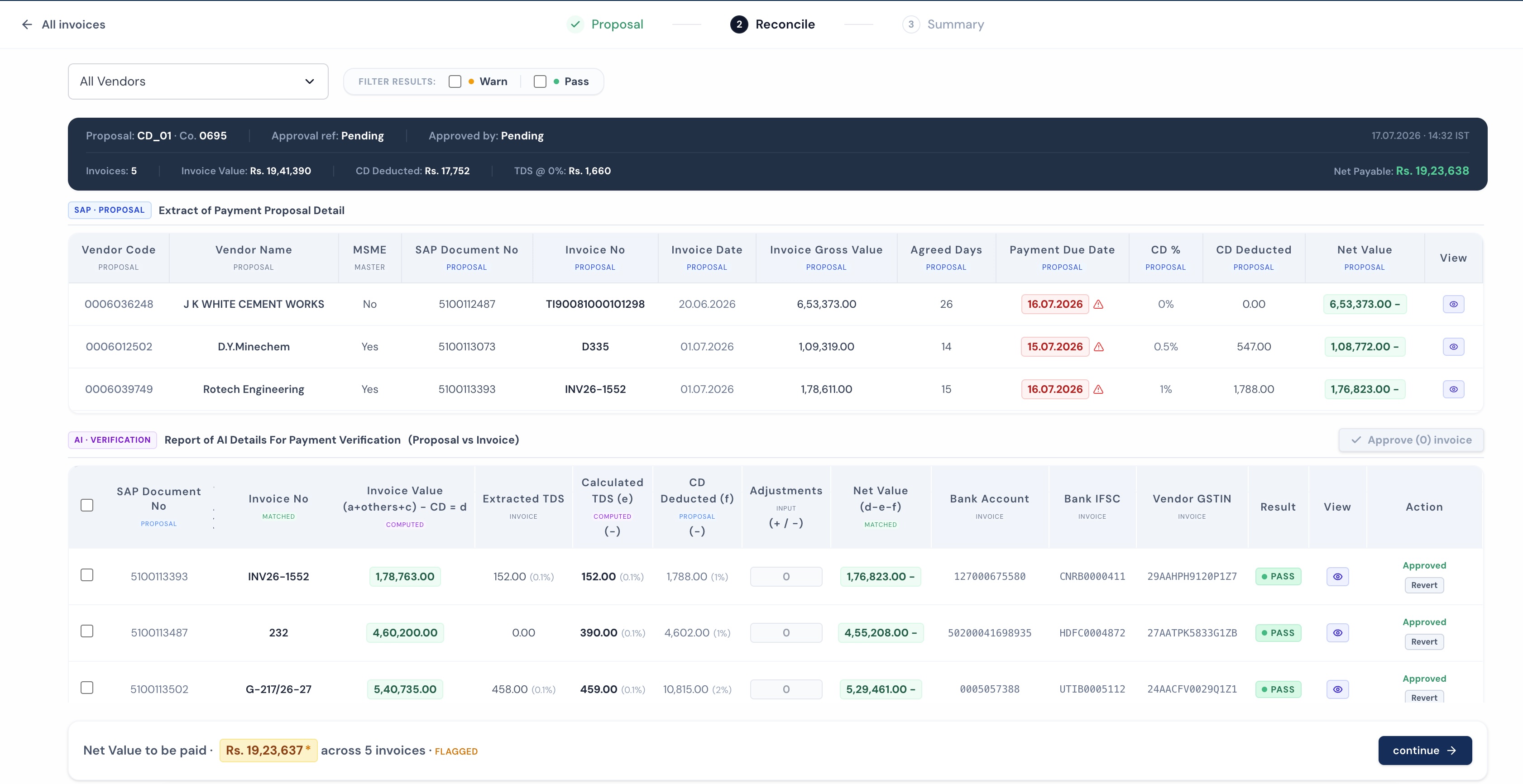
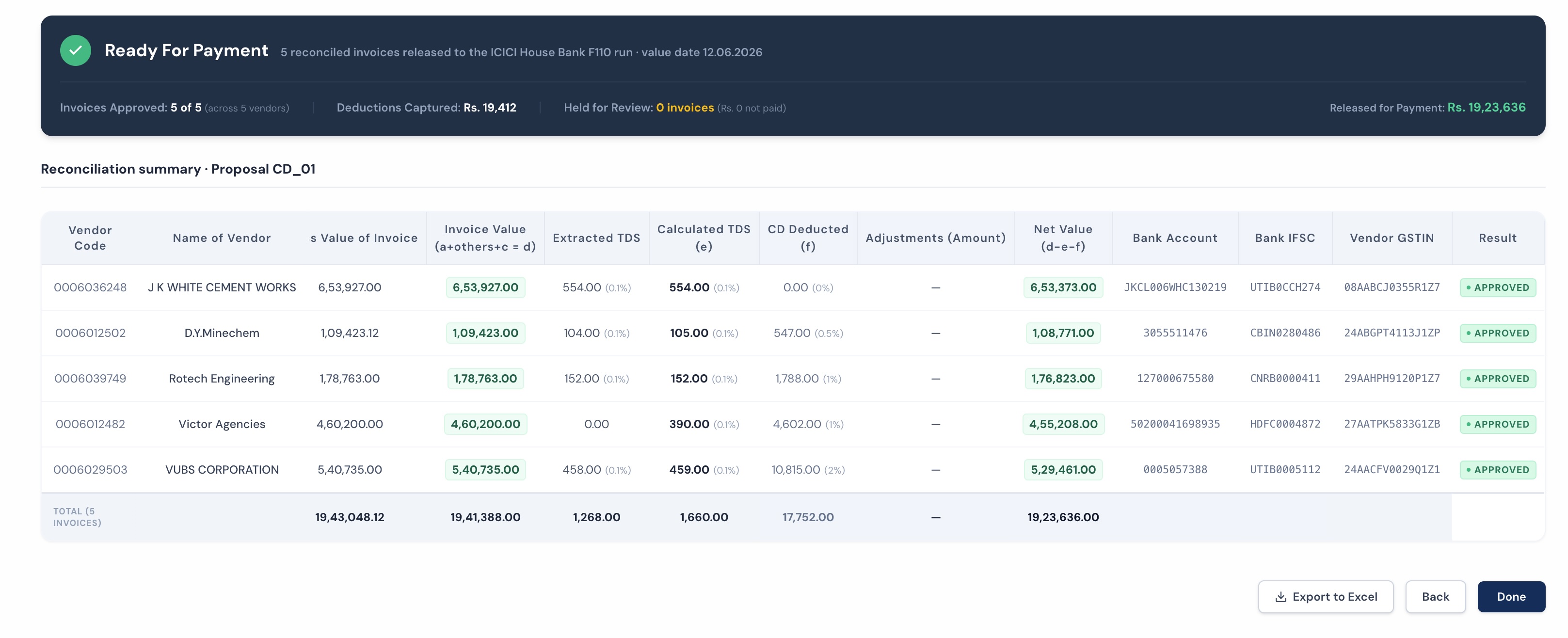
Multi-vendor AP payment proposals - each with invoice values, cash discounts and TDS - are checked by the Match Agent against invoice-level data before release to the bank payment run, with every result marked pass or held for review.
Orient Exchange
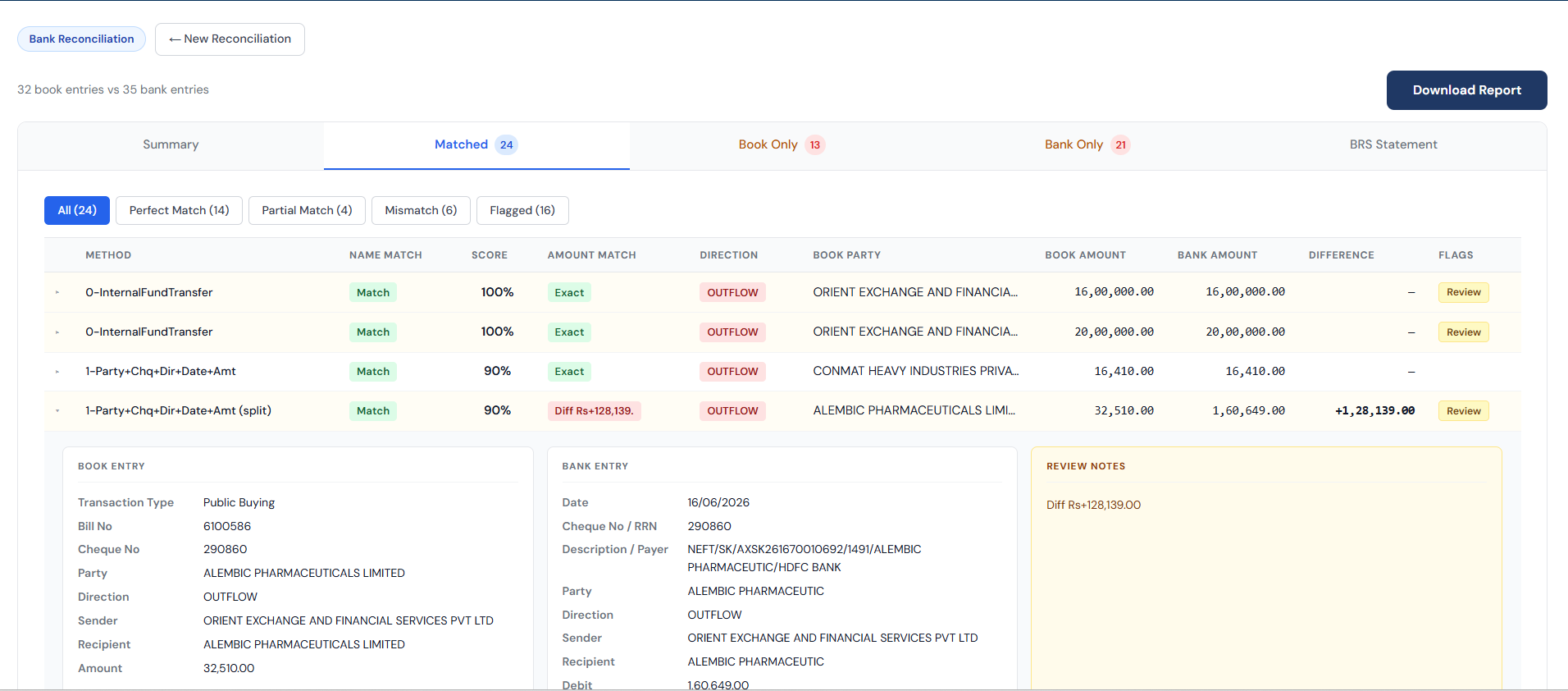
Book entries are reconciled against bank statement lines with a per-entry confidence score, split into perfect match, partial match, mismatch and flagged-for-review, with the underlying book and bank record shown side by side for every line.
Industries
Reconciliation looks different by industry - we've built for these
FAQ
Questions finance teams actually ask
Does Makez replace our ERP or accounting system?
No. Makez sits alongside SAP, Oracle, Tally, Zoho Books, QuickBooks, NetSuite and similar systems of record. It reads from them, reconciles across bank, vendor, tax and payment data, and writes matched entries and exceptions back - it does not replace the ledger itself.
What types of reconciliation does Makez handle?
Bank, invoice/AP, PO-to-invoice-to-payment (3-way and 4-way match), vendor statement, customer/receivables, intercompany, payroll, credit card/expense, inventory, treasury and cash positioning, payment gateway/settlement, and country-specific tax reconciliation - GST/TDS for India, sales tax/1099 for the US.
Does Makez support GST and TDS reconciliation for Indian entities?
Yes - the Tax Agent matches purchase registers against GSTR-2A and GSTR-2B for input tax credit, validates e-invoice IRNs, and reconciles TDS deducted in the books against Form 26AS and AIS ahead of return filing.
Does Makez support 1099 and sales tax reconciliation for US entities?
Yes - vendor payments are reconciled against W-9 records and 1099-NEC/1099-K thresholds, and sales and use tax collected is checked against state filing obligations, with an audit trail suited to a SOX-controlled close.
How long does it take to go live?
Most teams connect a first data source - usually a bank feed or the AP module of their ERP - and see matched results within two to three weeks, adding further reconciliation types afterward.
Who reviews the exceptions the agents can’t resolve?
Your team does. Every agent has a confidence threshold; anything below it goes to the Exception Agent, which routes it to the right person with full context rather than auto-closing it.
Bring both sides of your ledger together
Tell us what you're reconciling today - even if it's still in a spreadsheet - and we'll show you which agent starts first.