
AI for Accounts Receivable Reconciliation: Automate Payment Matching
Why collections teams spend a full week every cycle chasing remittances, and how AI accounts receivable automation is closing that gap without adding headcount.

Accounts receivable reconciliation, reimagined around AI that reads a remittance advice the way a person would, at machine speed.
- Most unapplied cash sits stuck for one of three reasons: TDS deducted at source, a partial payment, or a reference number that does not match anything in the ledger.
- AI accounts receivable automation reads the remittance, works out which invoices it actually covers, and only asks a person when it genuinely cannot tell.
- On a typical run, roughly two in three receipts clear themselves. The rest land in a queue with the reasoning already attached.
- Finance teams in Bangalore, Mumbai, Chennai, Pune, and beyond are already running this in production, not as a pilot.
Every collections team knows the feeling. A customer pays, the bank shows a credit, and somebody still has to sit down and work out which invoice, or invoices, that payment actually settles. The amount rarely matches exactly. TDS has been deducted at source. Two invoices got paid together. The narration on the bank statement says something like "NEFT XYZCORP" and nothing else. Multiply that by two hundred receipts a week and you have the real reason month end close takes as long as it does.
This is the part of finance that accounts receivable automation was always going to reach eventually, and it has. The shift underway right now is not a faster spreadsheet. It is AI accounts receivable software that reads a remittance the way a person would, works out what it actually pays for, and only stops to ask when a genuine judgment call is needed.
Where manual accounts receivable reconciliation actually breaks
Ask any collections lead where the week disappears and you will hear the same three answers, in some order.
- TDS on base amount. A customer pays an invoice net of tax deducted at source, and the receipt lands short of the invoice value for a completely legitimate reason. Someone has to work out the TDS component before the invoice can be marked settled.
- Partial and combination payments. A customer clears two or three invoices in a single transfer, or pays part of one invoice and carries the balance forward. A rules based system built for one to one matching simply cannot see this.
- Narration that says almost nothing. Bank statements are not designed for accounting. A generic reference code or a misspelled company name is often all there is to go on.
Every one of these is solvable by a person with enough time. The problem was never that collections teams could not do the matching, it is that doing it by hand does not scale past a certain transaction volume.
What AI accounts receivable automation actually does differently
AI accounts receivable automation is not a faster version of the same rule. A rule matches exact amounts and gives up on everything else. An agent reads the remittance advice, checks it against every open invoice for that customer, works out whether TDS, a partial payment, or a combination of invoices explains the gap, and assigns a confidence score to what it found.
- It clears exact matches, TDS net matches, and multi invoice combination matches on its own, with a written reason attached to each one.
- It separates overpayments, partial payments, and receipts it genuinely cannot identify into their own queues, instead of lumping everything into one generic exceptions list.
- It never silently drops a receipt. Carry forward and unidentified amounts stay visible until someone resolves them.
- It gets better with volume, because every reviewed exception feeds back into how the next one gets scored.
Inside a cash application software run
Here is roughly what a single run of automated cash application looks like in practice, on a batch of fifty incoming receipts.
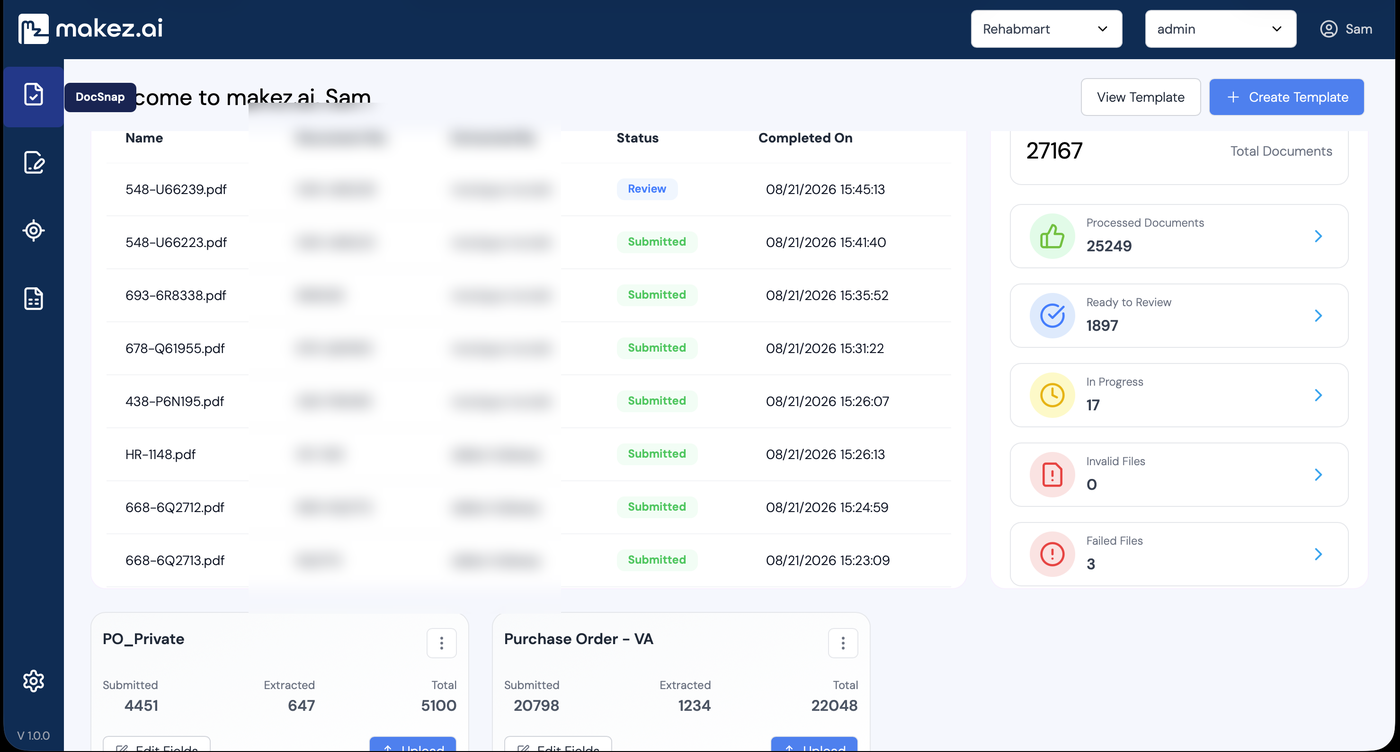
The same document workspace that reads a remittance advice for AR reconciliation is also where the underlying invoices and purchase orders live.
Of the thirty four receipts that clear on their own, most fall into two buckets: an exact match against a single invoice, or a TDS net match where the shortfall is explained entirely by tax deducted at source. A smaller number are multi invoice combinations, one transfer covering several invoices at once. The eight that land in a review queue usually involve a partial payment against a large open balance, or a narration too vague to resolve automatically, and each one arrives with the invoice, the customer, and the reasoning already laid out, not a blank spreadsheet cell.
Payment arrives
Bank credit or remittance advice received
Checked against open invoices
Every open balance for that customer compared
TDS, partial, or combination checked
The gap between receipt and invoice explained
Confidence check
Is the match certain enough to clear alone?
Auto cleared
Invoice marked settled, reason logged
Sent to review queue
With customer, invoice, and reasoning attached
None of this replaces your accounting system, it works alongside it. You can read more about how the same connectivity model runs across every ledger job on the Reconciliation Agent page, including bank, payables, GST and TDS, and intercompany matching, and how audit trails are attached to every decision on our Trust, Security & Governance page.
What actually moves the needle beyond the software itself
Cost savings alone rarely convince a finance leader that a new system is worth the switch. These are the changes that tend to matter more once automated accounts receivable is live:
- Collections staff spend their time on the accounts that genuinely need a phone call, not retyping remittance data.
- Days sales outstanding drops, because unapplied cash gets resolved in days instead of sitting in a suspense account for weeks.
- Month end close stops being a scramble, because the matching work is already done by the time the close checklist starts.
- Audit queries that used to take an afternoon to trace now take a few minutes, because every match already carries its own reasoning.
These are platform wide figures across the Makez.ai customer base, individual results vary by starting point and volume. One customer, Orient Exchange, reconciled 5,572 entries with 5,328 matched automatically, leaving 244 routed to a person, a pattern that holds up whether the ledger in question is bank, receivables, or vendor side.
Where Indian finance teams are automating AR reconciliation right now
This is not a future trend, it is already running in production across the country, and the pattern looks a little different by city.
- Bangalore based technology and SaaS companies are usually the earliest adopters, with subscription and usage based billing that generates a high volume of partial and combination payments every month.
- Mumbai finance teams, particularly at NBFCs and financial services firms, lean on payment reconciliation software to keep pace with high transaction volumes across multiple bank accounts and entities.
- Chennai manufacturers and exporters deal with a mix of domestic TDS netting and export remittances that rarely match invoice value exactly, a natural fit for AI invoice reconciliation.
- Pune auto component and engineering suppliers, often running multiple plants and legal entities, use AR reconciliation software to keep intercompany and customer ledgers in sync without a separate spreadsheet per site.
- Delhi NCR trading and distribution companies process high volumes of partial and staggered payments from a wide dealer network, exactly the pattern automated payment matching was built for.
- Hyderabad pharma and life sciences distributors run tight compliance calendars, where accounts receivable reconciliation software that keeps GST and TDS matching current all month makes filing week far less stressful.
Makez.ai itself is built out of Karnataka, with its largest team in Bangalore and its roots in Mangalore, which is part of why the product is built around real operational workflows rather than a generic finance dashboard. You can read more about that on our About Us page.
What to look for in accounts receivable reconciliation software
Not every tool marketed as AR automation software is built the same way. A few things separate the ones finance teams actually keep using:
- Handles TDS, partials, and combinations natively. If a tool only does one to one exact matching, it will only ever clear a fraction of real world receipts.
- Shows its reasoning. A confidence score with no explanation is not much better than a spreadsheet macro nobody trusts.
- Connects to the ERP you already run. Tally, SAP, Oracle, Zoho Books, QuickBooks, NetSuite, Microsoft Dynamics, and Sage should all be first class options, not a future roadmap item.
- Reads bank and gateway data directly. HDFC, ICICI, Axis, SBI, IndusInd, Kotak, and YES Bank statements, plus PayU, Cashfree, EaseBuzz, and Razorpay settlement reports, should plug in without a manual export step.
- Keeps an audit trail on every match, not just the exceptions. Auditors ask for the full picture, not a summary of what went wrong.
- Scales across entities. Multi GSTIN, multi currency, and multi subsidiary businesses need one dashboard, not one spreadsheet per branch.
See how this connects to the rest of the platform on our architecture page, or how a new matching rule gets tested safely before it ever touches a live ledger on the Agent Builder page.
Quick answers
Does AI accounts receivable automation replace the collections team?
No. It removes the manual matching work, reading remittance advices, splitting partial payments, netting TDS. The team still owns customer relationships and every judgment call, they just stop retyping data.
How is AI cash application different from a bank feed rule?
A rule matches exact amounts. Agentic AI reads a remittance advice, handles TDS netting, partial payments, and combination payments across multiple invoices, and explains its reasoning for every match instead of only handling the clean cases.
Is customer payment data safe with an AI reconciliation tool?
It should be processed inside your own environment, connected to your existing ERP and bank feeds rather than routed through outside infrastructure. That is a baseline requirement, not an optional extra.
Getting started
The broader shift here, toward financial reconciliation software that reads documents the way a person does rather than matching on exact amounts alone, is moving from pilot projects into daily use faster than most finance leaders expect. Every receipt processed adds to a system that keeps getting more accurate, which is a real head start over a competitor still reconciling by hand a year from now.
If you want to see this against your own receipts rather than a generic demo, get in touch and we will show you exactly how it would work on your ledger.
See it on your own receipts
Bring a real remittance advice or a month of unapplied cash. We will show you exactly how Makez.ai would clear it.
Book a demo